
TL;DR

Get business pricing on your home office setup
- Business-only prices and quantity discounts
- Tax-exempt purchasing
- Multiple users, one account, clear invoices
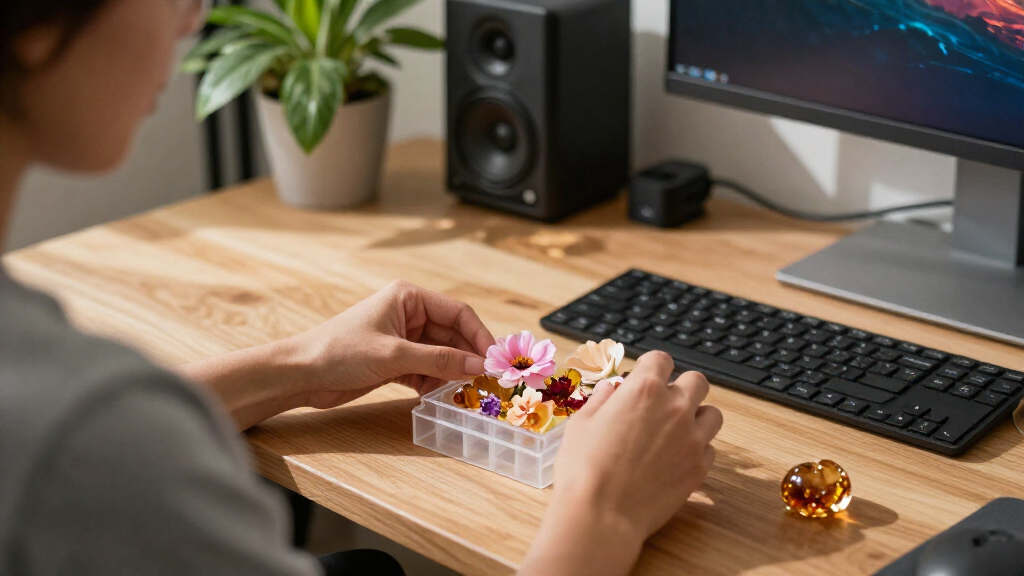
A Livingetc report describes a renewed interest in floral resin, with preserved flowers appearing in furniture, lighting and hospitality interiors. Designers and creative professionals interviewed by the outlet connect the appeal to nostalgia and the desire to hold a moment in time; the report does not establish how widespread the trend is across the design market.
Preserved flowers encased in resin are showing up in a range of recent interiors and design projects, according to a Livingetc report that tracks the material’s renewed visibility in furniture, lighting and hospitality spaces. The examples span a Paris herbal infusion house, designer collaborations and work by botanical artist Marcin Rusak, putting an older decorative technique back into conversations about contemporary interiors.
One featured example is Apoticari’s La Tisanerie, a herbal infusion house that opened in September in Paris’s Haut-Marais. The report describes its floral-enriched resin bar counter as an anchor for the venue’s botanical identity. The interior project is credited to architect Paul de Saint Maur, with table craftsmanship by Bankal et Decker.
Other examples include the Gelo side tables, designed by Paraforma for Monologue London and described as hand-cast in thick resin, and work by Rusak, whose practice incorporates botanical materials into objects. The report says Rusak is taking his Flora Herbarium Clear Amber 152 to Salon Art + Design in New York, scheduled for November 4–8 at the Park Avenue Armory.
Resin also appears in lighting and exhibition work cited in the report. Romain Casella, founder and director of creative agency MAY, points to Austrian designer Laurids Gallée’s Node 01 light and Dutch designer Sabine Marcelis’s work. Marcelis’s first solo museum exhibition, “Sabine Marcelis: Light and Color,” is listed as running at Zurich’s Museum für Gestaltung from October 30, 2026, to April 4, 2027.
Why Designers Are Preserving Flowers
The appeal is not limited to the material’s appearance. Resin keeps flowers visible inside an object, turning decoration into something that can suggest a preserved moment or memory. Casella told Livingetc that the effect combines current nostalgia with a deeper desire to “freeze time.” He compared it to the mosquito preserved in amber in the film Jurassic Park, saying the object remains still and present.
That idea gives floral resin a role beyond surface pattern: tables, counters and lights can function as conversation pieces with a botanical story. For venues such as La Tisanerie, the material also links the interior to the business’s focus on herbs and infusions. These are interpretations offered by the report’s interviewees and examples, rather than evidence that customers broadly prefer resin designs.
Products Worth Considering

DEWALT 20V MAX 1/4-Inch Impact Driver Kit with Battery and Charger (DCF787D1)

Metabo HPT NT1850DG 18V Cordless 18-Gauge Brad Nailer Kit

Metabo HPT Cordless Framing Nailer MultiVolt 21° Kit (NR1890DRA)
As an affiliate, we earn on qualifying purchases.
A Decorative Technique Reappears
Livingetc says floral epoxy resin furniture has roots in the 1940s and was revived in the 1980s. Its current return is presented alongside renewed interest in amber-toned interiors and a wider appetite for nostalgic design. The report also references the outlet’s Style Pulse S/S27 forecast, which names “One Decorative Gesture” as a design moment expected to influence interiors in the coming year.
The article’s examples reflect the writer’s observations across recent design destinations, including venues in Paris and work seen during Frieze Week, as well as projects encountered through design platforms and social media. They show the material appearing across different settings, but do not amount to market data or a survey of the design industry.
““Like the mosquito in amber in Jurassic Park, we’re deliberately choosing to freeze time — and there’s something reassuring in that in such unstable times: it doesn’t move; it’s there, still.””
— Romain Casella, founder and director of MAY, speaking to Livingetc
How Broad Is the Resurgence?
The report documents selected projects and designers, but provides no sales figures, market-wide survey or production data to measure how widespread floral resin has become. Its description of a rising trend is based on editorial observations and interviews, so it is not clear whether the visibility reflects sustained demand or a cluster of high-profile projects.
The source also does not detail the resin types, preservation methods or environmental impacts used across the cited work. Those factors may differ by maker and product. The article’s examples establish that the material is being used in these particular projects, not that all floral resin objects share the same process or properties.
Design Fair Offers a Next Look
One near-term opportunity to see the work is Salon Art + Design, scheduled for November 4–8, 2026, at New York’s Park Avenue Armory, where Rusak is expected to present Flora Herbarium Clear Amber 152. The report also lists Marcelis’s exhibition in Zurich, opening October 30, 2026, and running through April 4, 2027.
Further projects, exhibitions and market reporting may clarify whether floral resin’s current visibility develops into broader adoption. Until then, the confirmed evidence is a set of projects and venues highlighted by Livingetc, alongside designers’ explanations of what the material can communicate.
Key Questions
What is floral resin?
Floral resin refers to resin objects that incorporate flowers or other botanical materials, leaving them visible within the finished piece. The Livingetc report discusses its use in furniture, lighting and interior features.
Where is the resin trend appearing?
The report highlights Apoticari’s La Tisanerie in Paris, Paraforma and Monologue London’s Gelo side tables, and botanical artist Marcin Rusak’s work. It also cites lighting and exhibition projects by other designers.
Is floral resin a new design technique?
No. Livingetc traces floral epoxy resin furniture to the 1940s, with a revival in the 1980s. The current development described in the report is renewed visibility in selected contemporary projects.
Is the trend widespread across the furniture market?
The report does not provide sales data or a market survey. It shows that the material appears in several featured projects, but the scale of wider consumer demand remains unknown.
Source: livingetc.com