
TL;DR

Get business pricing on your home office setup
- Business-only prices and quantity discounts
- Tax-exempt purchasing
- Multiple users, one account, clear invoices
A Livingetc report published advice from Norwegian designer Gudbjørg Simonsen on adapting home lighting to short winter days. She recommends varied, layered light that supports practical tasks while creating warmth and atmosphere, rather than making every corner uniformly bright.
Norwegian designer Gudbjørg Simonsen has shared advice on lighting homes for short winter days, recommending that residents use layered, varied illumination and work with shadow instead of trying to make every room uniformly bright. Her approach, featured in a Livingetc report, draws on Norway’s seasonal changes and offers practical ideas for making indoor spaces both usable and welcoming.
Simonsen, who is based in Stavanger, told Livingetc that home design should account for light changing across the year. “I don’t think we can design homes as though light remains constant throughout the year,” she said. Rather than fight darkness, she said, a home can change character with the seasons as light, shadow, colors and materials are experienced differently.
One of her main recommendations is to avoid aiming for even illumination throughout a room. Simonsen said she values variation, drawing on the way natural light creates brighter areas, soft transitions and shadow. Her advice is to let some parts of a room remain dimmer instead of automatically trying to brighten every corner, which she said can make a space feel flat.
She also advocates layering different kinds of light. Practical or technical lighting should meet a room’s needs, such as illuminating a work surface, guiding movement or highlighting art. Simonsen said she prefers discreet or integrated fittings for these functions, so people experience the light without necessarily focusing on the fixture. The report also describes combining functional lighting with decorative accents, such as picture lights.
Lighting for Short Winter Days
The recommendations address a practical challenge for people spending more time indoors during darker months: rooms need enough light for everyday activities, but brightness alone may not create a comfortable atmosphere. Simonsen distinguishes between light that helps people see and light that helps a room feel warm and inhabited.
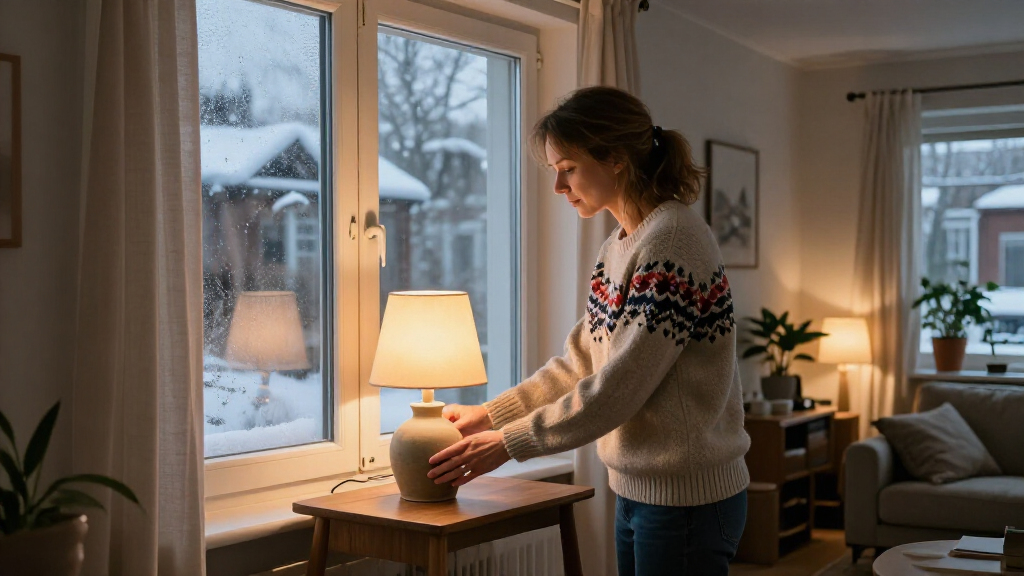
She told Livingetc that a warmly lit window can signal human presence on a dark evening. That idea places lighting in a social and emotional role as well as a functional one. For readers, her suggestions offer a way to think about winter lighting through task, atmosphere and contrast, rather than relying on one bright overhead source.
Products Worth Considering

DEWALT 20V MAX Cordless Compact Drill Driver Kit (DCD771C2)

WORX WG733.1 20V Cordless 14-Inch Lawn Mower

WORX 20V Brushless Cordless 18-Gauge Brad Nailer (WX838L.9)
As an affiliate, we earn on qualifying purchases.
Norway’s Seasonal Light Changes
The Livingetc report says Norway can have a maximum of six hours of daylight a day in December, with no daylight during winter in the country’s northernmost areas. Those conditions make seasonal changes a significant factor in how homes are designed and experienced.
Simonsen said her work considers both the environment around a home and the lifestyle of the person living in it. She also draws on traditional Norwegian architecture. The source presents her recommendations as a designer’s approach informed by climate and practice, not as formal guidance or a tested prescription for improving mood.
“I don’t think we can design homes as though light remains constant throughout the year. Nor do I think the answer is to fight the darkness.”
— Gudbjørg Simonsen, Norwegian designer, speaking to Livingetc
Limits of the Lighting Advice
The Livingetc material is an interview-based design report, not a clinical study. It does not provide evidence that a particular lighting arrangement prevents seasonal mood changes, nor does it quantify effects on sleep, health or well-being. Simonsen’s comments about warmth and human presence are her design perspective.
The supplied report excerpt also does not include all of the detailed guidance on decorative lighting, bulb types, brightness levels or placement. It gives no specific product recommendations or measurements, so readers should treat the advice as broad design principles rather than a step-by-step lighting plan.
Applying the Ideas at Home
The report’s practical direction is to start with what each room needs: identify areas requiring task light, then add other sources for atmosphere and visual interest. A work surface may need focused illumination, while a passage may need light that helps people move through it. Accent lights can highlight artwork or create a softer pool of brightness elsewhere.
Simonsen’s advice is to observe how natural light changes across a space and use a mix of brighter areas and softer shadows in response. The source does not announce a new project or a forthcoming policy change; the development is the publication of her recommendations. No further update or next milestone is specified.
Key Questions
What is Gudbjørg Simonsen’s main winter-lighting recommendation?
She recommends working with seasonal darkness through varied, layered lighting, rather than making every part of a room equally bright.
What does layered lighting mean in the report?
It means using different light sources for different purposes, including task lighting for practical needs and decorative or accent lighting for atmosphere or to highlight features.
Why does Simonsen prefer variation over even lighting?
She told Livingetc that natural light includes brighter areas, soft transitions and shadow, and that uniform illumination can make a room feel flat.
Does the report say these lighting ideas treat winter mood changes?
No. The report shares a designer’s advice and observations, but it does not provide clinical evidence that the suggestions treat seasonal mood or health conditions.
Source: rss