TL;DR

Get business pricing on your home office setup
- Business-only prices and quantity discounts
- Tax-exempt purchasing
- Multiple users, one account, clear invoices
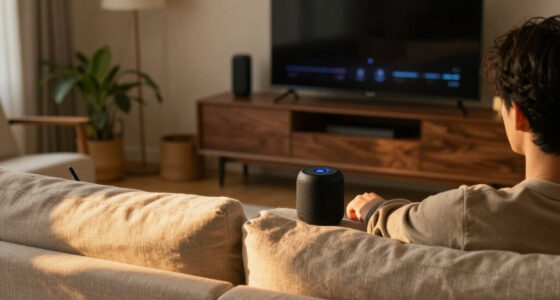
Apple’s $299 HomeView and Amazon’s $499.99 Echo Show 16 are new smart displays designed to help households manage calendars, smart-home controls and other shared information. The Verge’s hands-on report says both appear to address longstanding hardware and usability problems, but it is too early to know how well they work in everyday use.
Apple and Amazon have launched new smart displays that could give households a shared place to manage calendars, smart-home controls and daily routines, according to a hands-on report by The Verge. The $299 HomeView and $499.99 Echo Show 16 bring more capable hardware and household-oriented software to a product category that has struggled to find a clear purpose, though the report says both devices still need fuller testing.
The Verge’s reporter had brief hands-on time with both products. The report describes Apple’s HomeView as the company’s first smart display, with an A18 chip and Liquid Retina display. Amazon’s Echo Show 16 is described as a ground-up rebuild of the company’s smart display line, with a MediaTek processor and the same Nanomatte display used in its new Alexa Tablet.
The devices are intended for shared household tasks rather than traditional computer work such as homework or paying bills. The report points to checking a family calendar, viewing who is at the door, coordinating meals and controlling connected lights as examples. It says the Echo Show 16 includes a household homescreen with features such as a calendar and smart-home dashboard, as well as a meal-planning feature.
The two companies take different approaches to household use. Amazon positions the Echo Show 16 as a screen for the household that can be set up without a phone, while the report says an iPhone helps. Apple’s HomeView is more closely tied to the iPhone, with some apps relying on the phone and some features appearing to depend on phone proximity and face recognition. These descriptions come from demonstrations, not extended independent testing.
A fixed, shared display could make household information and controls accessible without relying on one person’s phone. The report describes calendars, grocery lists, meal plans and chores as information that often ends up on an individual’s device, while connected-home controls add another reason for a communal screen. If these products work as presented, multiple household members could check schedules, control lights or view a door camera from one place.
The price is a major difference from earlier smart displays cited in the report: the 2023 Echo Show 5 cost $85, and the Nest Hub cost $99. HomeView starts at $299, while the Echo Show 16 costs $499.99. The higher prices put more weight on whether the new devices offer reliable shared use and useful software, rather than simply serving as voice-assistant screens.
Products Worth Considering

EGO Power+ 9‑Gallon Wet/Dry Shop Vacuum with Remote Control (WDV0900) – Battery Not Included

WORX 20V Cordless 18-Gauge Brad Nailer, WX842L

WORX WG430 13-Amp Electric Leaf Mulcher
As an affiliate, we earn on qualifying purchases.
Why Smart Displays Needed a Reset
Three years before this launch, The Verge’s reporter argued that smart displays were underpowered and tried to do too many things without doing them well. The new products are presented as a response to that problem: more capable processors, displays designed for constant household use and software aimed at common domestic tasks. The report says both are meant to be always available and easy to use, without a PIN or a screensaver that must be dismissed before tapping a control.
The report also explains why a conventional tablet may not fill the same role. Tablets can have limited multiuser support, and portable devices may be taken away from the shared space or run out of battery. The writer’s experience with Google’s Pixel Tablet, a tablet that could dock as a smart display, included concerns about its detachable screen and smart-home support. The report says Google reportedly canceled a successor 18 months later; that detail is attributed to reporting, not presented as a statement from Google in this source material.
““These could finally turn the smart display into what it should have been all along: the family computer.””
— The Verge reporter
Everyday Performance Still Untested
The report is based on brief hands-on time, so it does not establish whether either display will perform reliably over extended household use. It remains unclear how well the devices handle multiple users, whether their shared features work smoothly across different household setups, and how useful their software will prove outside demonstrations.
Some of Apple’s capabilities appear to depend on a nearby iPhone, face recognition and access to personal information such as messages. The source describes a demonstration in which Siri used text messages to anticipate a visitor’s arrival and prompt a coffee machine, but it does not provide detailed information about how these features operate in practice or what settings and permissions they require. The report also does not establish the Echo Show 16’s full feature set, availability details or comparative performance over time.
Longer Tests Will Clarify Use
The next meaningful test is whether the HomeView and Echo Show 16 can support ordinary household routines beyond short demonstrations. That includes checking how easily family members can use the screens, how well calendars and smart-home controls work, and how much each device depends on a particular phone or account. The Verge’s report says its own impressions need proper testing; it does not give a timetable for that testing.
For buyers, the immediate comparison is between Apple’s more phone-connected design at $299 and Amazon’s more household-centered approach at $499.99. Until fuller testing and further product details are available, claims that either can become a dependable family hub remain promising but unproven.
Key Questions
What are the HomeView and Echo Show 16?
They are new smart displays from Apple and Amazon, respectively, intended to combine a screen and voice assistant with shared household information and smart-home controls.
How much do the two displays cost?
The Apple HomeView costs $299, and the Amazon Echo Show 16 costs $499.99, according to the source report.
How do Apple and Amazon’s approaches differ?
The report says Amazon’s Echo Show 16 is designed to work as a household screen and can be set up without a phone. Apple’s HomeView is more closely connected to the iPhone, and some features appear to rely on a nearby phone and user recognition.
Can either device replace a family computer?
The report uses “family computer” to describe a shared screen for calendars, door cameras, meals and connected-home controls—not a device for homework or paying bills. Whether either display works well for those shared tasks has not yet been established through extended testing.
What is still unknown about the new displays?
The available hands-on impressions are brief. Long-term reliability, multiuser performance and the practical limits of phone-dependent features remain unclear.
Source: theverge.com