
TL;DR

Get business pricing on your home office setup
- Business-only prices and quantity discounts
- Tax-exempt purchasing
- Multiple users, one account, clear invoices
Toronto framing expert Tara Gavin says a gallery wall works best when it follows a clear design direction. Her approach uses deliberate frame and mat choices, negative space and, in some cases, black-and-white photographs to bring a collection together.
Toronto framing expert Tara Gavin recommends giving a gallery wall a clear design direction, using frames, mat colors and photo arrangements as parts of a single composition. In a House Beautiful report, the founder of On the Wall Framing explains how those choices can help a collection of personal photographs and prints feel connected without relying on identical frames or a uniform layout.
Gavin’s approach was illustrated by a gallery wall she curated for a Toronto family of five with design studio Kessler Levitan. The available wall was just 31 inches wide, making the project an example of how a narrow area can still be treated as a designed display. The report does not give measurements for the individual frames or spacing.
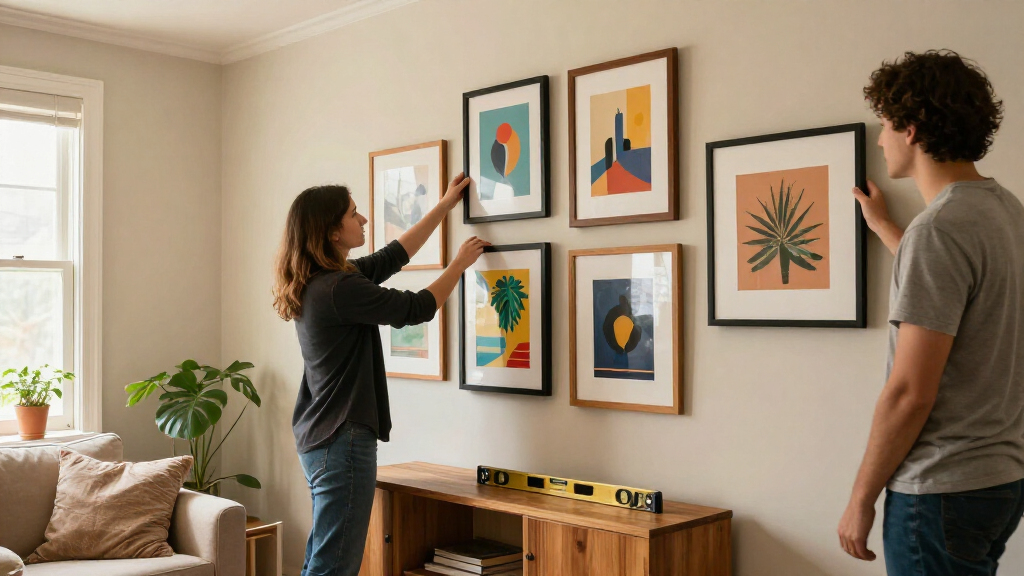
Rather than use only white mats and wood frames, Gavin combined oak and black frames with burgundy-toned mats and frames. She said burgundy adds warmth, oak keeps the arrangement from feeling too formal, and black provides contrast that ties the composition together. She also suggested choosing a mat color that relates to a prominent shade in a room, while noting that white is not the only suitable option.
Matting and placement are also part of the design. Gavin said her team may use multiple openings in one frame or position photographs off-center instead of always centering one image. For the featured family-photo display, the photographs were printed in black and white to create consistency across images taken at different times and in different lighting. Gavin presented monochrome printing as a possible tool, not a requirement for every gallery wall.
How Design Choices Unite the Display
The advice matters to readers because family photographs and collected prints often vary in color, style and age. Gavin’s method offers several ways to connect those differences: repeat selected frame finishes, introduce a shared mat color, adjust the space around images or use monochrome printing. These are design recommendations from a framing professional, rather than rules established by a formal standard.
The report also frames a gallery wall as a way to display personal photographs, not only purchased art. Gavin said meaningful family images can serve as art in the home. Her example suggests that a constrained wall area need not rule out a display, though the source does not provide a step-by-step hanging plan or prescribe a minimum wall size.
Products Worth Considering

DEWALT DWM120K Deep-Cut Portable Band Saw, 10 Amp

EGO Power+ 10” Cordless Pole Saw with Telescopic Shaft and LED Cut Line Indicator

EGO Power+ Cordless Electric Leaf Blower, 880 CFM, with Two 4.0Ah Batteries (LB8803-2)
As an affiliate, we earn on qualifying purchases.
The Toronto Wall Behind the Advice
House Beautiful’s report centers on a commission by Kessler Levitan for a Toronto family of five. Gavin was asked to curate a display for a wall only 31 inches wide. The source describes the resulting mix of frame finishes, burgundy accents and black-and-white family images, but does not identify the room, the number of photographs or the family’s specific preferences.
Gavin described her studio’s approach as experimenting with scale, mat color, frame finishes and photo positioning. The report translates that approach into three broad ideas: select a palette beyond default white, use mat space and varied arrangements deliberately, and consider black-and-white printing to reduce visual differences among photographs.
“My team and I love playing with scale, unexpected mat colors, different frame finishes, and the way photographs are positioned within a frame in order to keep them fresh.”
— Tara Gavin, founder of On the Wall Framing
Details the Report Does Not Give
The source does not provide a full installation guide, such as exact spacing between frames, hanging heights, hardware recommendations or a method for mapping the layout before installation. It also does not report the cost of the commission or compare the result with other gallery-wall arrangements. Gavin’s comments are professional design advice, and the report does not offer independent testing or evidence that one palette or photo treatment works best for every room.
It is also unclear whether the family requested black-and-white photographs or whether that decision was made solely as part of the design. The report describes the choices in this particular project; it does not say that readers must use burgundy, oak, black frames or monochrome prints.
Applying the Ideas at Home
The report gives no announced follow-up, product release or additional milestone. Readers adapting Gavin’s method can start by deciding what they want the display to connect—such as a recurring frame finish, a mat color drawn from the room or a consistent treatment for photographs—then plan the arrangement around the available wall space. Those are practical applications of the reported advice, not additional steps specified by Gavin.
Whether a particular mix of images and frames feels cohesive will depend on the room and the collection. The source does not provide a template or guarantee a result, so the specific combination remains a matter of design preference.
Key Questions
What is Tara Gavin’s main advice for a gallery wall?
Gavin’s central recommendation is to give the display a clear design direction. In the House Beautiful report, she describes using scale, mat colors, frame finishes and photo placement to make the pieces work as a composition.
Does a gallery wall need matching frames?
No. Gavin’s featured example combined oak, black and burgundy elements. She said the colors can play different roles, including warmth, contrast and visual connection.
Why use black-and-white family photos?
Gavin said monochrome printing can bring consistency to family pictures taken at different times, in different lighting and with different color palettes. The report presents it as an option, not a requirement.
How can mats change a gallery wall?
Gavin describes mat space as a way to give an image more room and make it feel distinct. She also recommends considering multiple openings in one frame or placing images off-center rather than using the same centered arrangement throughout.
Can a narrow wall work for a gallery display?
Gavin’s example involved a wall that was 31 inches wide, which she described as a design opportunity. The source does not provide a minimum width or a layout formula for other spaces.
Source: housebeautiful.com