For most home offices, I’d start with the Samsung 49-inch Business Curved Ultrawide: its Dual QHD workspace, USB-C connectivity, and adjustable stand make it the most complete single-screen workstation here. The LG 34WR55QK-B is a more manageable curved WQHD choice, while the Dell S3425DW stands out for its 120Hz refresh rate and eye-comfort focus. The central tradeoff is screen area versus desk space, resolution, and the convenience of a work-friendly connection setup. Some models prioritize a broad, immersive canvas; others provide sharper 34-inch workspaces or gaming-oriented motion features. Read on for how these eight options compare and which one best suits your home office.

Get business pricing on your home office setup
- Business-only prices and quantity discounts
- Tax-exempt purchasing
- Multiple users, one account, clear invoices
Complete the kit


Key Takeaways
- The Samsung 49-inch Business model leads for multitasking: Dual QHD space and USB-C make it the most workstation-focused pick, but its size calls for a generous desk.
- WQHD is the stronger 34-inch work format: The LG 34WR55QK-B and Dell S3425DW offer more workspace detail than the WFHD LG 34U530A-W.
- USB-C availability varies even among similar-size monitors: The LG 34U530A-W lists USB-C, while the two 34-inch Samsung ViewFinity S50GC listings do not.
- The S50GC listings are close relatives, not clear stand-ins for one another: Check the exact model and listed features before buying, since their descriptions differ.
- Gaming features are not the same as office ergonomics: The Samsung Odyssey G5’s 1000R curve suits immersive use, while its gaming emphasis may be unnecessary for routine desk work.


| ultrawide monitors for home office | Resolution | Refresh rate | Display size | Aspect ratio |
|---|---|---|---|---|
| Samsung 49" Business Curved Ul | 5120 x 1440 pixels (Dual QHD) | 120Hz | 49 inches | 32:9 |
| LG 34U530A-W 34-inch UltraWide | 2560 x 1080 | 100Hz | — | 21:9 |
| Samsung 34" ViewFinity S50GC S | 3440 x 1440 pixels | 100Hz | 34 inches | 21:9 |
| SAMSUNG 34" ViewFinity S50GC S | 3440 x 1440 pixels | 100Hz | 34 inches | 21:9 |
| Samsung 34" ViewFinity S5 | 3440 x 1440 pixels | 120Hz | 34 inches | 21:9 |
| Dell 34 Monitor S3425DW | 3440 x 1440 | 120Hz | 34 inches | — |
| Samsung 34′ Odyssey G5 Ultra-W | 3440 x 1440 | 165Hz | 34 inches | — |
| LG 34WR55QK-B 34-inch UltraWid | 3440 x 1440 | 100Hz | 34 inches | 21:9 |
More Details on Our Top Picks
Samsung 49″ Business Curved Ultrawide Dual QHD Monitor with USB-C, HDMI, DisplayPort, 120Hz, HDR 400, Built-in Speakers, Height Adjustable Stand, Eye Care (LS49C954UANXZA, 2024)
For a home office built around several open windows, the 49-inch, 32:9 screen can replace the visual space of two QHD monitors while avoiding a central bezel. Its 5120 x 1440 resolution gives spreadsheets, documents, and video calls room to sit side by side. Compared with the 34-inch Samsung ViewFinity S50GC, this model offers much more width and adds USB-C with 90W charging, Ethernet, and built-in speakers, making it a more self-contained desk setup. The tradeoff is physical: at 32.2 pounds, it needs a wide, sturdy desk, and its size may be excessive for ordinary office tasks. Picture-by-Picture mode also limits the refresh rate, so it is less flexible for users who want two separate inputs and the full 120Hz experience at once.
Pros:- 32:9 Dual QHD workspace can reduce the need for a second monitor.
- USB-C supports up to 90W charging, with HDMI, DisplayPort, and Ethernet also listed.
- Height-adjustable stand helps tailor the large screen to a seated home-office setup.
- Built-in speakers can reduce desk clutter for calls and everyday audio.
Cons:- The 49-inch panel demands substantial desk width and a sturdy surface.
- Picture-by-Picture mode does not support the full 120Hz refresh rate.
- Screen brightness does not automatically adjust to changing ambient light.
Best for: Remote professionals who routinely work across multiple full-size windows and have a deep, wide desk with room for a 49-inch display.
Not ideal for: People with compact desks, occasional multitaskers, or users who need full 120Hz operation while using Picture-by-Picture.
- Display size:49 inches
- Aspect ratio:32:9
- Resolution:5120 x 1440 pixels (Dual QHD)
- Refresh rate:120Hz
- Brightness:400 cd/m²
- HDR:DisplayHDR 400
- Connectivity:DisplayPort, HDMI, USB-C, Ethernet
- Stand and audio:Height-adjustable stand; built-in speakers
Our verdict“Choose this Samsung if your home office needs a single, expansive workspace and your desk can accommodate its unusually wide footprint.”
LG 34U530A-W 34-inch UltraWide WFHD IPS Computer Monitor, 100Hz, HDR400, HDMI, DisplayPort, USB-C, Adjustable Stand
The LG 34U530A-W pairs a practical 34-inch, 21:9 layout with an IPS panel and USB-C, making it a more approachable fit than the enormous 49-inch Samsung for a typical home-office desk. Its wide canvas gives documents and reference windows room to share the screen, while 100Hz keeps scrolling and cursor movement smooth. The listed 99% color gamut and DisplayHDR 400 support add appeal for general creative tasks, though neither changes the main limitation: its 2560 x 1080 resolution is less detailed than the 3440 x 1440 Samsung ViewFinity models. That lower pixel count can mean less vertical workspace and a softer view of fine text. The adjustable stand and USB-C are useful conveniences, but the limited USB ports and software-dependent features make it less of a complete docking setup than its connectivity list might suggest.
Pros:- 34-inch 21:9 screen adds room for side-by-side work without a 49-inch footprint.
- IPS panel and 178-degree viewing angle suit shared viewing and varied seating positions.
- USB-C, HDMI, and DisplayPort provide several ways to connect a computer.
- Adjustable stand and 100Hz refresh rate support a more comfortable daily setup.
Cons:- 2560 x 1080 resolution provides less vertical workspace and detail than 3440 x 1440 alternatives.
- USB port selection is limited.
- Some features require software installation, adding setup steps.
Best for: Home-office users who want a manageable 34-inch ultrawide, USB-C connectivity, and an IPS viewing angle without needing 1440-pixel vertical resolution.
Not ideal for: People who spend long days reading dense text or editing detailed images and want the sharper 3440 x 1440 workspace offered by the Samsung ViewFinity S50GC.
- Screen size:34 inches
- Aspect ratio:21:9
- Resolution:2560 x 1080
- Panel technology:IPS
- Refresh rate:100Hz
- Brightness:400 cd/m²
- HDR:DisplayHDR 400
- Ports:1 HDMI, 1 USB-C, 2 component outputs, 1 USB 2.0
Our verdict“Pick the LG if USB-C and a 34-inch ultrawide matter more to you than the sharper resolution of the Samsung ViewFinity models.”
Samsung 34″ ViewFinity S50GC Series Ultrawide QHD Monitor, 100Hz, 5ms, HDR10, AMD FreeSync, Eye Care, Thin Bezels, PIP, PBP, Black
The Samsung ViewFinity S50GC is the strongest all-around fit here for home-office work that benefits from readable detail without an oversized display. Its 3440 x 1440 resolution gives a 34-inch, 21:9 panel more vertical workspace than the LG 34U530A-W’s 2560 x 1080 screen, which helps when reviewing long documents or keeping a spreadsheet beside a browser. The 100Hz refresh rate, FreeSync, and Picture-in-Picture and Picture-by-Picture modes add flexibility for mixed work and entertainment. Eye-care features, including automatic brightness adjustment, are a useful distinction from the Samsung 34-inch S50GC variant listed without that feature. The compromise is connectivity: this model lists only DisplayPort and HDMI, with no USB-C or built-in speakers mentioned. Its 300 cd/m² brightness is also below the LG’s listed 400 cd/m².
Pros:- 3440 x 1440 resolution provides sharper text and more vertical room than the LG 34U530A-W.
- 21:9 format supports side-by-side windows without the desk footprint of the 49-inch Samsung.
- Automatic brightness adjustment and blue-light reduction support extended work sessions.
- Picture-in-Picture, Picture-by-Picture, 100Hz, and FreeSync offer flexibility beyond basic office use.
Cons:- Connectivity is limited to DisplayPort and HDMI; USB-C is not listed.
- No built-in speakers or USB hub are specified.
- 300 cd/m² brightness is lower than the LG 34U530A-W’s listed 400 cd/m².
Best for: Remote workers who spend much of the day in documents, spreadsheets, and browser windows and want sharp 34-inch ultrawide resolution with eye-care features.
Not ideal for: Laptop users who want a single USB-C cable for display and charging, or anyone who needs built-in speakers or a USB hub.
- Display size:34 inches
- Aspect ratio:21:9
- Resolution:3440 x 1440 pixels
- Refresh rate:100Hz
- Response time:5ms
- Brightness:300 cd/m²
- HDR:HDR10
- Connectivity:DisplayPort, HDMI
Our verdict“Choose the S50GC if crisp text, a comfortable 34-inch workspace, and eye-care features matter more than USB-C convenience.”
SAMSUNG 34″ ViewFinity S50GC Series Ultra-WQHD Monitor, 100Hz, 5ms, HDR10, AMD FreeSync, Eye Care, Borderless Design, PIP, PBP, LS34C502GANXZA, 2023, Black
This ViewFinity S50GC variant delivers the same useful 3440 x 1440 resolution and 21:9 work area as the other Samsung S50GC, but its standout is a borderless design that makes more sense when pairing screens or keeping the desk visually uncluttered. It also lists two HDMI inputs plus DisplayPort, giving it a clearer multi-device advantage over the other S50GC, which lists only HDMI and DisplayPort without port counts. For home-office documents and everyday multitasking, its 100Hz refresh rate and eye-care features offer a solid mix. The tradeoff is that the provided color-gamut figure is 72%, below the 99% listed for the other S50GC and the LG 34U530A-W, so color-sensitive creative work is a weaker fit. Like its Samsung counterpart, it lacks listed USB-C and built-in speakers.
Pros:- 3440 x 1440 resolution keeps text and work windows detailed across a 34-inch screen.
- Borderless styling suits a desk with a second monitor.
- Two HDMI inputs plus DisplayPort support multiple connected video sources.
- 100Hz refresh rate, FreeSync, and eye-care features serve work and casual entertainment.
Cons:- Listed 72% color gamut is lower than the 99% figures supplied for the other S50GC and LG models.
- USB-C is not listed, limiting one-cable laptop setups.
- No built-in speakers are specified.
Best for: Home-office users building a tidy dual-screen setup who want a borderless 34-inch ultrawide with multiple video inputs.
Not ideal for: Color-focused designers or laptop users who need USB-C display connectivity and charging from the monitor.
- Display size:34 inches
- Aspect ratio:21:9
- Resolution:3440 x 1440 pixels
- Refresh rate:100Hz
- Response time:5ms
- Brightness:300 cd/m²
- Color gamut:72%
- Connectivity:2 x HDMI 2.2, 1 x DisplayPort 1.2
Our verdict“Choose this S50GC for a borderless multi-screen desk and extra HDMI inputs, but favor the other S50GC for a stated 99% color gamut.”
Samsung 34″ ViewFinity S5 (S55GH) Ultrawide QHD Curved Monitor
The Samsung ViewFinity S5 (S55GH) brings a curved 34-inch, 21:9 screen to buyers who want an immersive work surface without stepping up to the 49-inch Samsung’s desk-filling width. Its 3440 x 1440 resolution matches the two flat ViewFinity S50GC models, while the 120Hz refresh rate exceeds their 100Hz for smoother scrolling and motion. The VA panel’s listed 3000:1 contrast ratio can give text and images stronger separation than the LG 34U530A-W’s listed 1000:1 ratio. It also includes speakers and eye-comfort features, unlike the S50GC models as described. But this model’s port data is sparse: one HDMI and two component outputs are listed, with no DisplayPort or USB-C specified. Buyers who need dependable laptop docking or several modern video inputs may be better served by the S50GC or LG.
Pros:- 3440 x 1440 resolution provides detailed room for side-by-side office windows.
- Curved 21:9 panel creates a more enveloping viewing layout than the flat S50GC models.
- 120Hz refresh rate is higher than the 100Hz rate on the other 34-inch ViewFinity options.
- Built-in speakers and Eye Saver Mode add convenience for everyday desk use.
Cons:- Only one HDMI input is listed, and USB-C and DisplayPort are not specified.
- 300 cd/m² brightness and HDR10 provide less stated HDR headroom than the LG’s 400 cd/m² DisplayHDR 400.
- Curved styling and 34-inch width may not suit buyers who prefer a flat, compact display.
Best for: Home-office users who prefer a curved 34-inch screen, want 3440 x 1440 detail and 120Hz smoothness, and value built-in speakers.
Not ideal for: Laptop-first workers who require USB-C charging, or multi-device setups that need several clearly specified modern video inputs.
- Display size:34 inches
- Aspect ratio:21:9
- Resolution:3440 x 1440 pixels
- Panel technology:VA
- Refresh rate:120Hz
- Contrast ratio:3000:1
- HDR:HDR10
- Ports:1 HDMI, 2 component outputs
Our verdict“Pick the curved S5 if smooth motion, contrast, and built-in speakers appeal more than flexible USB-C connectivity.”
Dell 34 Monitor S3425DW, WQHD VA, 120Hz, FreeSync Premium, Eye Comfort
The Dell S3425DW is a strong fit for home-office users who want a roomy workspace without giving up smooth motion or rich color. Its 3440 x 1440 resolution gives you space for side-by-side documents, while 99% sRGB and 95% DCI-P3 coverage make it better suited to color-conscious tasks than the Samsung Odyssey G5, whose listed color gamut is 72%. The 120Hz refresh rate also makes scrolling and everyday motion feel smoother than on the LG 34WR55QK-B at 100Hz. USB-C with up to 65W power delivery can simplify a laptop setup, and the speakers add a practical convenience. The tradeoff is that this remains a 34-inch display, not a substitute for the much wider Samsung 49-inch Business monitor, and the listed 300 cd/m² brightness may be limiting in a bright room.
Pros:- 3440 x 1440 resolution supports side-by-side work without a second monitor
- 99% sRGB and 95% DCI-P3 coverage suit color-conscious projects
- USB-C supports up to 65W power delivery for compatible laptops
- 120Hz refresh rate and FreeSync Premium support smooth motion
Cons:- 34-inch screen offers less total workspace than the Samsung 49-inch Business monitor
- 300 cd/m² listed brightness may be less suitable for rooms with strong daylight
- Only a 1-year warranty is specified
Best for: Home-office laptop users who want a 34-inch multitasking screen, broad color coverage, and USB-C charging for a simpler desk setup
Not ideal for: People who need a 49-inch workspace, or those working in a very bright room who want higher listed brightness
- Display size:34 inches
- Resolution:3440 x 1440
- Panel type:VA
- Refresh rate:120Hz
- Color coverage:99% sRGB, 95% DCI-P3
- Brightness:300 cd/m²
- Connectivity:USB-C (up to 65W), 2 HDMI, 4 USB
- Speakers:2 x 10W
Our verdict“Choose the Dell if you want a color-forward 34-inch home-office display with USB-C charging and smoother motion than a standard 100Hz option.”
Samsung 34′ Odyssey G5 Ultra-Wide Gaming Monitor with 1000R Curved Screen
The Odyssey G5 earns its place for home-office buyers whose desk also serves as a gaming station. Its 165Hz refresh rate and 1ms MPRT response time are the strongest motion-focused specifications in this group, while the 1000R curve wraps the 34-inch screen more tightly than the Dell S3425DW or LG 34WR55QK-B. That can feel immersive in games, though the pronounced curvature is less neutral for document work and may take some adjustment. The 3440 x 1440 resolution still gives you room for multiple windows, but the listed 72% color gamut is less compelling for color-sensitive work than the Dell’s broader coverage. It also lacks USB-C, so it is a less convenient laptop-docking choice than the Dell or LG. At 250 cd/m², it is better suited to controlled lighting than a sunlit office.
Pros:- 165Hz refresh rate is higher than the Dell S3425DW and LG 34WR55QK-B
- 1000R curve creates an immersive view for games
- 3440 x 1440 resolution provides room for work windows and entertainment
- FreeSync Premium and HDR10 support are included
Cons:- No USB-C connection for a streamlined laptop setup
- 250 cd/m² brightness may be limiting in a bright home office
- 72% listed color gamut is less suited to color-critical work than the Dell
Best for: Home-office users who spend substantial time gaming and want a high-refresh-rate ultrawide on the same desk
Not ideal for: Laptop-first workers seeking USB-C connectivity or people doing color-sensitive work who need broader listed color coverage
- Display size:34 inches
- Resolution:3440 x 1440
- Panel type:VA
- Curvature:1000R
- Refresh rate:165Hz
- Response time:1ms (MPRT)
- Brightness:250 cd/m²
- Connectivity:DisplayPort, HDMI, 3.5mm audio
Our verdict“Pick the Odyssey G5 if gaming performance matters more to you than USB-C convenience, brighter output, or broad color coverage.”
LG 34WR55QK-B 34-inch UltraWide WQHD Curved Monitor with Adjustable Stand
The LG 34WR55QK-B stands out for buyers who want a broad home-office canvas and more control over screen placement. Its height-adjustable stand is a meaningful advantage over setups that offer tilt alone, making it easier to position the display for a comfortable seated posture. The 3440 x 1440 resolution and 21:9 format suit side-by-side apps, while USB Type-C joins HDMI and DisplayPort for flexible connections. Compared with the Dell S3425DW, the LG tops out at 100Hz rather than 120Hz and lists 99% sRGB without the Dell’s stated 95% DCI-P3 coverage. That makes the Dell the stronger match for users who prioritize color range and smoother motion. The LG’s 5ms response time is less gaming-focused than the Odyssey G5, and it has no built-in speakers or USB hub functionality.
Pros:- Height and tilt adjustments help position the screen for a more comfortable desk setup
- 3440 x 1440 resolution and 21:9 aspect ratio support side-by-side work
- USB Type-C, HDMI, and DisplayPort provide flexible connection options
- 99% sRGB coverage supports everyday color-conscious work
Cons:- 100Hz refresh rate is below the Dell S3425DW and Samsung Odyssey G5
- No built-in speakers or USB hub functionality
- OnScreen Control features require software installation
Best for: Remote workers who spend long hours at a desk and want height adjustment, ultrawide multitasking space, and USB-C connectivity
Not ideal for: Competitive gamers seeking a high refresh rate, or users who need built-in speakers or USB hub functionality
- Display size:34 inches
- Resolution:3440 x 1440
- Aspect ratio:21:9
- Refresh rate:100Hz
- Response time:5ms
- HDR:HDR10
- Color coverage:99% sRGB
- Stand adjustments:Tilt, height
- Connectivity:DisplayPort, HDMI, USB Type-C
Our verdict“Choose the LG if adjustable screen height and a practical USB-C ultrawide matter more than higher refresh rates or built-in audio.”
How We Picked
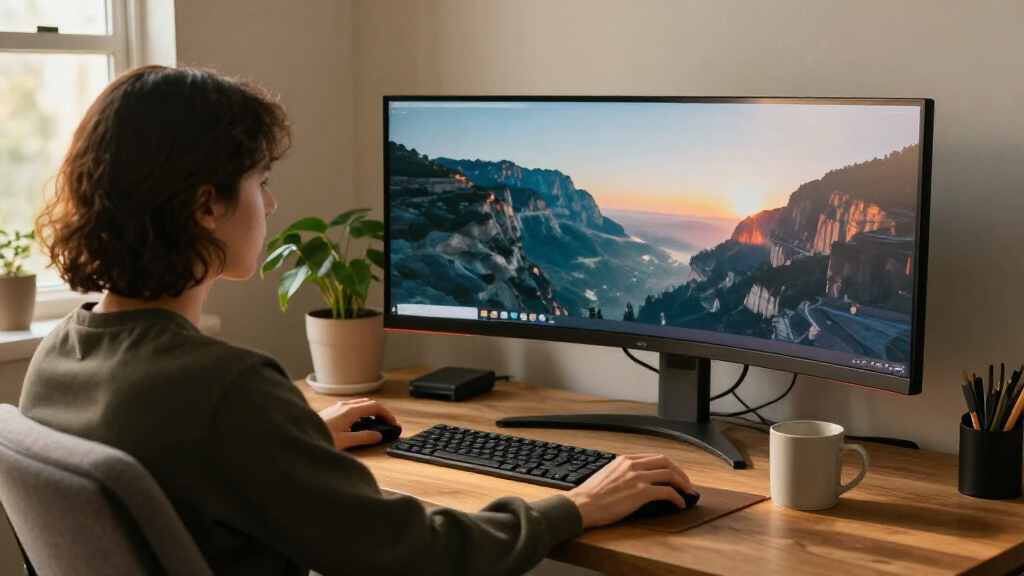
I ranked these monitors by how well their listed features serve everyday home-office work: readable workspace, useful connectivity, ergonomic adjustment, and flexibility for mixed work and entertainment. Screen size and resolution matter together; a larger panel can fit more windows, but it also needs more desk depth and a comfortable viewing distance. I gave extra weight to USB-C where it can simplify a laptop setup, and to adjustable stands and eye-comfort features that can support long desk sessions.
The order reflects those priorities rather than treating refresh rate or a curved panel as automatic advantages. The Samsung 49-inch Business model ranks first for its combination of Dual QHD workspace and USB-C; the LG 34WR55QK-B and Dell S3425DW follow as more compact WQHD alternatives with distinct strengths. Models with WFHD resolution or gaming-first positioning rank lower for general office use, while the similar Samsung S50GC listings are separated by the features stated in their individual descriptions. Product details can vary by exact model and listing, so I recommend checking the model number and connection specifications before purchase.
| ultrawide monitors for home office | HDR |
|---|---|
| Samsung 49" Business Curved Ul | DisplayHDR 400 |
| LG 34U530A-W 34-inch UltraWide | DisplayHDR 400 |
| Samsung 34" ViewFinity S50GC S | HDR10 |
| SAMSUNG 34" ViewFinity S50GC S | — |
| Samsung 34" ViewFinity S5 | HDR10 |
| Dell 34 Monitor S3425DW | — |
| Samsung 34′ Odyssey G5 Ultra-W | — |
| LG 34WR55QK-B 34-inch UltraWid | HDR10 |
Factors to Consider When Choosing Ultrawide Monitors For Home Offices
Choosing an ultrawide for a home office is less about maximizing inches and more about fitting the display to your desk, computer, and work habits. I’d weigh these five factors before deciding, especially when similar-looking 34-inch models differ in resolution or connectivity.
Match Screen Width to Desk Depth
A wide display can reduce the need to switch between windows, but it also occupies more of your visual field. Measure the available desk width and depth, then account for the stand and space for a keyboard, laptop, or speakers. A 49-inch monitor can replace a two-screen setup, yet may feel overwhelming on a shallow desk or at a short viewing distance. A 34-inch model is easier to accommodate, though it provides less room for several full-size windows. Don’t choose by diagonal measurement alone: the curve and stand footprint affect how the screen fits your room. If you work at a compact desk, a smaller panel with a well-positioned laptop may be more comfortable than the largest screen you can fit.
Choose Resolution for the Work You Actually Do
Resolution determines how much detail and usable workspace you get, not just how large text appears. For spreadsheets, documents, and side-by-side windows, WQHD on a 34-inch ultrawide generally gives a more detailed workspace than WFHD at a similar size. WFHD can still suit basic office tasks, particularly if larger text is a priority or the computer is modest, but it gives you less fine detail for dense layouts. Also check that your computer can output the monitor’s native resolution at its intended refresh rate through the connection you plan to use. Scaling settings can make text easier to read, but excessive scaling reduces the practical space advantage. Pick the resolution around your typical workload rather than assuming more screen area alone will solve cramped multitasking.
Treat USB-C as a Setup Feature, Not a Guarantee
USB-C can make a laptop-based office simpler by carrying video and, on some displays, power or data through one cable. The connection label alone does not promise laptop charging, so check the monitor’s power-delivery specification and the power your laptop requires. If the display only sends video over USB-C, you may still need a separate charger and cable. HDMI and DisplayPort remain useful for desktop computers and docks, but they do not provide the same one-cable convenience by themselves. Before buying, list the ports on your computer, dock, and monitor and confirm they work together at the resolution and refresh rate you want. This check can matter more to daily convenience than a modest bump in refresh rate.
Prioritize Ergonomics Before Extra Refresh Rate
A stand that adjusts for height can help place the screen at a more comfortable eye level, especially during long work sessions. Check whether the monitor adjusts for tilt and swivel too, and whether it supports a VESA mount if you use an arm. Eye-care features are useful supporting details, but they cannot compensate for poor screen height, glare, or an uncomfortable viewing distance. Refresh rates above basic office needs can make scrolling and pointer movement look smoother, though they may matter less for documents than for gaming or fast-moving content. A 100Hz or 120Hz panel can serve mixed-use households well, but don’t sacrifice a suitable stand or resolution just to get a faster refresh rate. Match the screen’s physical setup to your posture before paying extra for motion features.
Decide Whether Curvature Helps Your Work
A curved ultrawide can bring the outer edges closer to your line of sight, which may feel natural when working across the full width. The effect depends on screen size, curve strength, and how far you sit from the display. A pronounced curve such as the Odyssey G5’s 1000R design is more immersive, but can be less appealing if you regularly share the screen with someone beside you or do layout work that benefits from straight visual references. A milder curve or flat panel may suit a single-user office where documents and spreadsheets dominate. Curvature is a preference and workspace fit question, not a measure of image quality. If possible, check the curve in person or confirm the return policy before choosing an especially pronounced design.
Frequently Asked Questions
Is the 49-inch Samsung a sensible choice for a single-laptop home office?
It can be, if your desk has enough width and depth and you regularly keep several windows open. Its Dual QHD workspace and USB-C make it the clearest one-screen replacement for a multi-monitor setup in this group. The tradeoff is that the panel takes up far more visual and physical space than a 34-inch monitor. Check your laptop’s USB-C capabilities and the monitor’s power-delivery details rather than assuming one cable will handle everything. If your work is mostly one document at a time, a 34-inch WQHD model may be easier to place and use.
Should I choose a 34-inch WQHD monitor over the LG WFHD model?
For dense spreadsheets, detailed documents, or keeping multiple windows legible, I’d generally favor a 34-inch WQHD option such as the LG 34WR55QK-B or Dell S3425DW. WQHD gives that screen size more detail than WFHD, which can make fine text and complex layouts easier to manage. The LG 34U530A-W may still suit buyers who value its listed USB-C connection and don’t need as much pixel detail. Your computer’s output capability and preferred text size matter too. Compare the exact resolution and connection specifications before choosing based on the shared 34-inch size.
Do I need USB-C on an ultrawide monitor for my home office?
No, but it can simplify a laptop workspace when the monitor supports the functions your computer needs. Confirm whether USB-C carries video and whether it supplies enough charging power; those capabilities are not guaranteed by the connector alone. A desktop PC or a well-equipped dock may make HDMI or DisplayPort perfectly adequate. Also account for any webcam, storage, or other devices you expect to connect, since monitor USB features differ by model. In this roundup, USB-C is specifically listed for the 49-inch Samsung Business monitor and LG 34U530A-W, so verify the exact listing rather than inferring it from brand or screen size.
Are the two Samsung ViewFinity S50GC listings different monitors?
The listings share the ViewFinity S50GC name and many stated specifications, including a 34-inch ultrawide format, 100Hz refresh rate, and HDR10. Their descriptions differ on details such as thin bezels versus borderless design and the exact model identifier, so I would not assume every listed feature or included item is identical. Check the model number, resolution, ports, and stand details on the seller’s page before placing an order. This is especially useful if you are comparing them side by side or replacing an existing display. If the specifications match your needs, choose by verified listing details rather than small wording differences alone.
Is a gaming-focused ultrawide a good choice for office work?
It can work well for office tasks, particularly if you also play games or want a more immersive screen. The Samsung Odyssey G5’s pronounced 1000R curve and gaming positioning are less directly tied to common office needs than stand adjustment, readable resolution, and laptop connectivity. A strong curve may suit a single-user desk but can be less comfortable for sharing the screen or viewing straight-line design work. For a work-first purchase, compare its ergonomics and ports with office-oriented options such as the LG 34WR55QK-B or Samsung Business model. Choose the gaming display when its mixed-use strengths matter to you, not just because its refresh features sound more advanced.
Conclusion
For the best overall home-office workstation, I’d choose the Samsung 49-inch Business Curved Ultrawide if your desk can accommodate it and you’ll use its expansive Dual QHD workspace and USB-C. For a best value shortlist, compare the 34-inch Samsung ViewFinity S50GC models by verified listing specifications; they offer 100Hz and practical multitasking features without the 49-inch footprint. The best premium-style productivity pick is still the Samsung Business model, while the best for beginners is the LG 34WR55QK-B: its 34-inch WQHD format is a straightforward move into ultrawide work without committing to a very large screen. For USB-C on a 34-inch panel, look at the LG 34U530A-W and confirm its WFHD resolution fits your work. If you want gaming alongside office use, the Odyssey G5 is the specialist choice; if smooth motion and eye-comfort features matter more, consider the Dell S3425DW. Match desk fit, resolution, and connections to your routine, and the right pick becomes clear.