
TL;DR

Get business pricing on your home office setup
- Business-only prices and quantity discounts
- Tax-exempt purchasing
- Multiple users, one account, clear invoices
A Livingetc report examines how more than one rug can work in an open-plan room, drawing on advice from designers Ann Marie Cousins and Marie Flanigan. Rugs can mark out separate living and dining zones or be layered in one seating area, but designers caution that side-by-side rugs may feel disconnected in smaller rooms.
Livingetc has published design advice on using more than one rug in an open-plan room, with designers describing how rugs can distinguish living and dining areas or add a smaller accent layer to a seating group, much like these tips for making an open-plan living room cosy. The report says the approach depends on the room’s size and layout: poorly coordinated or crowded placements may make zones feel disconnected rather than joined.
Ann Marie Cousins, founder of AMC Design, says rugs can help zone open-plan spaces without adding walls. A larger rug under a sofa and chairs can anchor a lounge area, while another beneath a dining table can give that zone a separate visual identity, as shown in this example of zoning an open-plan living room. The report says the rugs need not match, but can share a color or comparable level of contrast.
For a single seating area, designer Marie Flanigan recommends layering a larger, understated rug with a smaller accent rug. In her approach, the base rug grounds the furniture, while the upper layer can bring in a stronger pattern, vintage design or accent color. The report presents layering as an option when a preferred rug is too small to cover the area by itself.
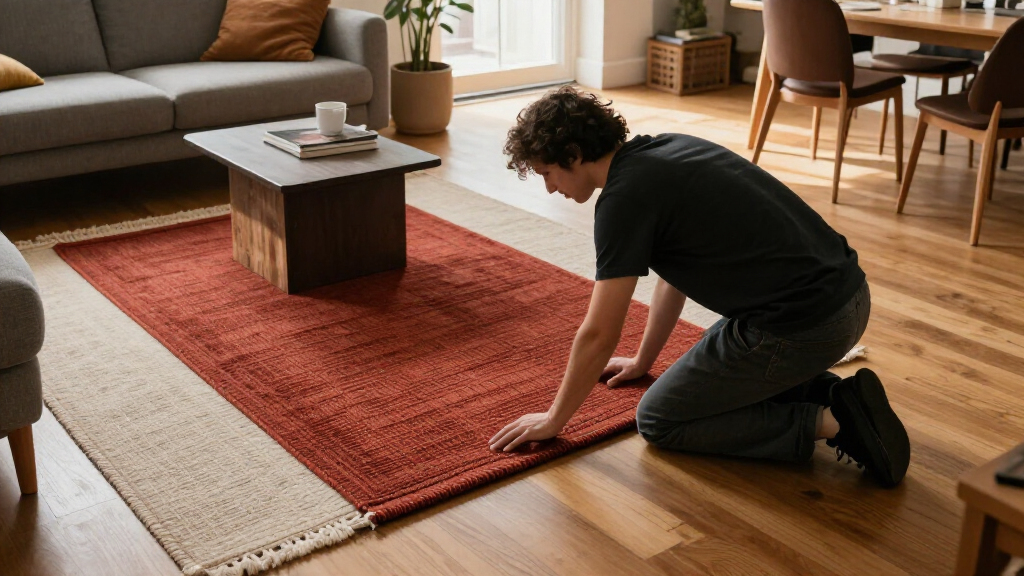
Side-by-side rugs may suit a large room with distinct furniture groupings, but Flanigan cautions that the arrangement can make a space feel disconnected. Cousins says two rugs can also be placed together when a single oversized rug is unavailable, with the join hidden beneath furniture such as a coffee or dining table where possible.
Rugs Mark Zones Without Walls
In an open-plan home, living, dining and kitchen areas may share one footprint, leaving furniture and decor to signal how each part is used. Rugs offer a soft visual boundary while keeping sightlines open. That can help a seating group feel grounded and a dining area feel distinct without physically dividing the room.
The advice also points to a practical design trade-off: adding rugs is not automatically a solution. A pair that is too small, too busy or awkwardly spaced can fragment the floor. The designers’ guidance places room scale and visual coordination at the center of the decision, rather than treating multiple rugs as a rule for every open-plan layout.
Products Worth Considering

DEWALT 10-Inch Jobsite Table Saw with Scissor Stand (DWE7491X)

Bosch GTS15-10 10-Inch Portable Jobsite Table Saw with Gravity-Rise Wheeled Stand

DEWALT 15 Amp 8-1/4-Inch Compact Portable Jobsite Table Saw (DWE7485)
As an affiliate, we earn on qualifying purchases.
Layering Versus Separate Zones
The Livingetc report frames the choice around how the room is used. Side-by-side rugs are intended to mark separate areas, such as a lounge and dining space. Layered rugs, by contrast, sit within one seating arrangement: a larger, quieter foundation beneath a smaller, more expressive accent.
To connect different designs, the report suggests repeating a color, balancing a bold pattern with a restrained one, or using texture as a link. It also advises considering the rest of the room, including flooring, upholstery and artwork. For different uses, the report notes that a flatweave can suit a dining table, while a softer pile may make a seating area feel more inviting.
““Rugs are a great way to zone a space within your home, working particularly well in open-plan layouts such as a living room.””
— Ann Marie Cousins, founder of AMC Design
Fit Depends on the Room
The report offers design recommendations, not a fixed sizing formula or a universal rule for how far apart rugs should sit. It does not provide measurements, a method for assessing traffic flow, or advice for every flooring type. Whether two rugs will feel connected will depend on the room’s dimensions, furniture placement and chosen designs.
The source also does not report a survey, product test or measured outcome. Its conclusions are attributed to the named designers and should be read as professional guidance, not as evidence that one arrangement will work in every home.
Measure Before Choosing Rugs
The practical next step is to map out the furniture groups and decide whether the goal is to separate zones or layer one seating area. The report’s advice points toward checking rug scale against the furniture, looking for a shared color or texture, and considering where a join would fall before buying or placing rugs. No further study or follow-up announcement is identified in the supplied material.
Key Questions
Can a room have more than one rug?
Yes. The Livingetc report says multiple rugs can mark separate areas in an open-plan room or be layered within one seating area. The layout and scale determine whether the result feels cohesive.
Should two rugs in the same room match?
They do not have to be identical. The report suggests connecting them through a repeated color, balanced patterns or complementary textures.
Is it better to layer rugs or place them side by side?
Layering is presented as a way to add an accent to one seating group. Side-by-side rugs can define separate zones, but the designers caution that the arrangement may feel disconnected, especially if the room is small or the placements are awkward.
How can two rugs placed together look more seamless?
Ann Marie Cousins suggests hiding the join beneath furniture, such as a coffee table or dining table, when placing rugs side by side. The report says this technique is most suited to a larger room when one rug is not available in the required size.
Source: livingetc.com