
TL;DR

Get business pricing on your home office setup
- Business-only prices and quantity discounts
- Tax-exempt purchasing
- Multiple users, one account, clear invoices
A House Beautiful report outlines five ways to make coordinated rooms feel more personal: mix wood tones, give a kitchen island a distinct look, combine dining-chair styles, contrast artwork and vary fixture finishes. The designers interviewed recommend repeating a few details to keep the mix cohesive, but the report does not establish that these changes raise a home’s value or suit every room.
A House Beautiful report lays out five designer strategies for breaking up rooms that rely too heavily on matching furniture, colors or fixtures, including mixing wood tones and pairing different dining chairs. The advice matters to homeowners and renters looking to make a coordinated space feel more individual, though the designers’ recommendations are guidance rather than evidence that any one approach works in every home.
The report’s first suggestion is to mix light and dark wood tones instead of repeating one finish across every surface. Leah Hook, founder and principal designer at Gray Oak Studio, says her firm likes combining darker and lighter woods. Repeating one tone in a frame or tray can help connect the pieces without making them identical.
For kitchens, Gaelle Dudley, founder and creative director at GLDESIGN, suggests giving an island a different stone from the surrounding counters. She also proposes a thicker edge profile, offering two inches as an example compared with a standard 1.25-inch thickness. The report presents these as design options, not requirements; the suitability and cost of a change will depend on the kitchen and materials.
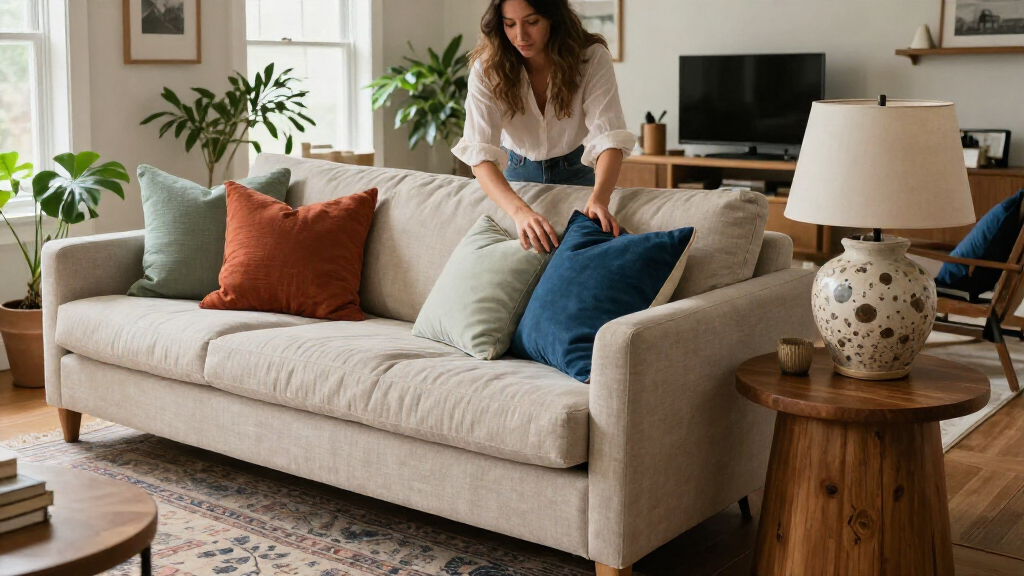
Dining rooms can use chairs from different collections, including secondhand finds, while retaining one repeated feature to make the grouping feel intentional. The report advises checking chair height and clearance behind seats. For artwork, it recommends mixing styles and frame materials while keeping a detail such as mat size or frame width consistent. Its final tip is to combine fixture finishes, such as brass and matte black, rather than repeating one finish throughout.
Small Choices, More Personal Rooms
The suggestions offer a practical alternative to replacing an entire matching set: homeowners can introduce contrast through a few pieces or finishes while leaving much of the room intact. That can make coordinated spaces feel less uniform and allow furnishings, art and materials to reflect individual preferences.
The designers’ advice also stresses balance. Contrast is not the same as using unrelated elements without a plan: repeating a wood tone, chair detail or frame dimension can help a room read as cohesive. For renters or people on a budget, artwork, chairs and smaller accessories may be easier to change than counters or built-in fixtures.
Products Worth Considering

Greenworks 60V 25-Inch Self-Propelled Lawn Mower with Two 4.0Ah Batteries

RYOBI P1819 18V ONE+ 6-Tool Lithium-Ion Combo Kit

EGO POWER+ HT2600 26-Inch Cordless Hedge Trimmer (Battery and Charger Not Included)
As an affiliate, we earn on qualifying purchases.
Five Ways to Break the Set
The House Beautiful article addresses a familiar decorating choice: buying furniture and accessories as coordinated sets can simplify decisions, but may leave a room feeling overly uniform. Preeti Shah, founder and principal designer at Spotlight Style, says that a home can look sterile when everything comes from the same set. This is her assessment, not a measured finding about all coordinated interiors.
The report’s five tips span different parts of a home: wood tones in offices and living spaces; stone on kitchen islands; chairs around dining tables; artwork and frames; and hardware or plumbing finishes. The examples and suggestions come from designers quoted in the article, including Shah, Hook, Dudley, and Pattie Kelly, a certified interior decorator and owner of Inspired Home Interiors.
“A home often looks sterile when everything comes from the same set.”
— Preeti Shah, founder and principal designer at Spotlight Style
What the Design Advice Cannot Prove
The source is a design-advice report based on professional recommendations and examples, not a controlled comparison of matching and mixed interiors. It does not establish that these changes will make a home more valuable, look more expensive to every viewer, or suit all layouts and tastes. It also provides no project budgets or estimates for changing stone, cabinetry hardware or other fixed finishes.
Whether a mix looks intentional depends on the room’s scale, materials, use and existing furnishings. The report offers practical checks—such as chair clearance and repeating a detail—but does not provide a single formula for how many styles or finishes to combine.
How to Apply the Suggestions
The article does not announce a product launch, renovation project or follow-up study. Its next step for readers is practical: identify the part of a room that feels most uniform, then test one source of contrast before changing several elements at once. A different chair pair, artwork combination or accessory can be easier to trial than new counters or fixtures.
For more permanent changes, homeowners can compare materials, dimensions and costs with appropriate professionals before committing. The design advice itself remains general; readers will need to judge the results in their own rooms and make sure any proposed work fits the space and budget.
Key Questions
What does “matchy-matchy” mean in the report?
It refers to a room where furnishings, wood tones, artwork or finishes are coordinated so closely that the space may feel uniform. The report presents this as a design concern, not a rule that matching pieces are always undesirable.
What are the five designer suggestions?
Mix wood tones, give a kitchen island a distinct stone or edge profile, combine dining chairs from different collections, contrast artwork and frames, and vary fixture finishes.
How can different pieces still look cohesive?
The designers recommend repeating one detail, such as a wood tone, a chair feature, mat size or frame width. The report suggests this can connect varied elements without requiring them to match throughout.
Does the article say these changes increase home value?
No. The report offers design recommendations and does not provide evidence or data about resale value, renovation returns or changes in property prices.
Source: housebeautiful.com