
TL;DR

Get business pricing on your home office setup
- Business-only prices and quantity discounts
- Tax-exempt purchasing
- Multiple users, one account, clear invoices
Standing desk converters are portable, affordable, and perfect for small spaces, while full desks offer more stability and room for accessories. Your choice hinges on workspace size, budget, and how often you want to switch between sitting and standing.
Imagine slipping seamlessly from sitting to standing without rearranging your entire workspace. That’s the promise of both standing desk converters and full desks. But which one suits your lifestyle — and your space?
Choosing the right setup isn’t just about price or looks. It’s about finding a solution that encourages movement, feels stable, and fits your daily routine. In this guide, you’ll see how these options stack up, so you can make a confident call that boosts your comfort and productivity.
Assess your available space and choose a compact converter for small areas or a full desk for dedicated workspaces.
Budget and stability are key: converters are cheaper and portable, while full desks support longer, more ergonomic setups.
Both options can promote healthier work habits if adjusted properly, but quality matters — especially for supporting heavy equipment.
Recent innovations like electric height adjustment and hybrid designs make switching between sitting and standing easier.
Prioritize your daily routine and workspace constraints to pick the setup that encourages movement without sacrificing comfort.
Standing Desk Converter vs Full Desk: How to Decide
TL;DR: converters are portable, affordable, and smart for small spaces. Full desks offer more stability, surface area, and room for ergonomic accessories. Your best choice depends on workspace size, budget, equipment weight, and how often you want to switch posture.
Fast upgrade, low commitment, and easy to move between work zones.
Higher upfront cost, but stronger support for permanent ergonomic setups.
Switching every 30 minutes only works when the setup makes movement feel effortless.
Alternate sitting and standing to reduce prolonged-sitting strain.
Many converters fit compact desks and shared work surfaces.
Dedicated desks better support multiple monitors and accessories.
Converters usually install quickly with minimal furniture changes.
The Core Tradeoff
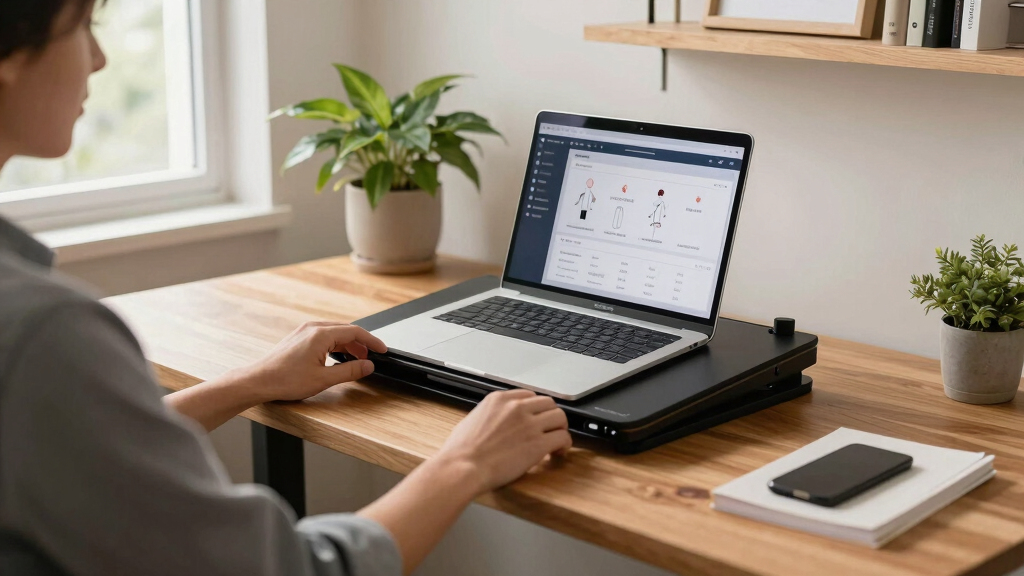
A converter is a movable platform on your existing desk. A full desk is dedicated furniture. Both can support healthier work habits, but they solve different workspace problems.
Standing desk converter
Choose this when your space is tight, your budget is modest, or you need a setup that can move between rooms. Quality matters because wobble can undermine comfort.
Full sit-stand desk
Choose this for a permanent workstation with monitors, arms, trays, mats, storage, and heavier gear. It costs more and needs more room, but feels more planted.
Ease beats intention
The healthiest option is the one you will actually adjust. Smooth lifting, proper monitor height, straight wrists, and a stable surface make movement sustainable.
Step-by-Step Decision Flow
Work through the constraints in order: space first, then budget, mobility, ergonomic load, and daily routine. The right answer should remove friction from movement.
Measure Space
Small or shared desks favor a converter. Dedicated rooms can absorb a full desk.
Set Budget
Converters are usually cheaper. Full desks are stronger long-term investments.
Check Mobility
Move often? Pick portable. Stay fixed? Prioritize a stable workstation.
Count Gear
Multiple monitors and accessories need tested weight limits and surface area.
Match Routine
Choose the setup that makes switching posture feel natural every day.
Prolonged sitting is linked with cardiovascular, obesity, and musculoskeletal risks. Both options can help, but unstable or awkward equipment can erase the benefit.
- ✓Monitor at eye level
- ✓Wrists straight and relaxed
- ✓Feet supported when seated
- ✓Regular posture changes
Side-by-Side Comparison
Use this table to pressure-test the choice against the realities of your workspace, not just the product category.
| Decision Factor | Standing Desk Converter | Full Sit-Stand Desk | Decision Signal |
|---|---|---|---|
| Cost | ✓ Usually $50-$300 | ~ Starts near $200, premium electric models exceed $1,000 | Choose converter for a fast, budget-conscious upgrade. |
| Space | ✓ Compact and ideal for tight desks | ~ Needs a dedicated footprint | Small apartments and shared surfaces favor converters. |
| Stability | ~ Depends heavily on model quality and weight limits | ✓ More stable for heavy equipment | Multiple monitors point toward a full desk. |
| Mobility | ✓ Easy to move, store, and share | ✗ Usually stationary once assembled | Changing locations often favors a converter. |
| Customization | ~ Good for simple height changes | ✓ Better for arms, trays, mats, storage, and cable routing | Complex ergonomic setups favor full desks. |
Best-Use Spectrum
Converters cluster near flexibility and budget. Full desks cluster near stability, equipment capacity, and long-term ergonomic customization.
Traceability: From Constraint to Choice
The decision becomes clearer when you map each workspace constraint to the product feature that removes friction.
Limited footprint points to a compact converter.
Lower upfront spend favors a converter.
Smooth adjustment supports regular posture shifts.
Heavy gear raises the value of a full desk.
Monitor arms and trays need stable support.
Pick the setup you will adjust consistently.
Choose a converter if…
You have limited space, want a lower-cost upgrade, share a workstation, or move between rooms. Prioritize a sturdy base, smooth lift, and verified weight capacity.
Choose a full desk if…
You are building a permanent office, use multiple monitors, need accessory space, or want electric adjustment with a stable, dedicated surface.
What’s the real difference between a standing desk converter and a full desk?
Standing desk converters are like mini stages you place on your existing desk. They lift your keyboard and monitor, letting you switch from sitting to standing in seconds. Full desks, on the other hand, are dedicated furniture—bigger, more stable, and designed to hold everything from multiple monitors to filing cabinets.
Understanding this difference helps clarify how each setup impacts your workflow and ergonomic health. Converters offer flexibility and quick adjustments, which are ideal for dynamic work environments or shared spaces. However, they may compromise stability when supporting heavier equipment, potentially leading to wobbling or uneven surfaces. Full desks provide a dedicated, stable surface that can be customized with ergonomic accessories, supporting longer work sessions comfortably. The tradeoff is that full desks require more space and a larger initial investment. Recognizing these implications helps you choose a setup that aligns with your work habits and space constraints, ensuring sustained comfort and productivity.
adjustable standing desk converter
As an affiliate, we earn on qualifying purchases.
As an affiliate, we earn on qualifying purchases.
How do size, cost, and mobility impact your choice?
Size and budget are big factors. Standing desk converters are compact — often just 24 inches wide — making them perfect for tight spaces. They usually cost between $50 and $300. Full desks are larger, ranging from $200 for basic models to over $1,000 for premium, electric options.
Mobility matters too. Converters are lightweight and easy to pack away, ideal if you work in multiple spaces or share a desk. Full desks are heavier and stay put, best for a dedicated workspace.
Suppose you frequently move between coffee shops and home. A converter can slide into your bag, providing instant ergonomic benefits wherever you go. Conversely, if your work environment is stationary, a full desk offers a more stable, permanent solution with added storage options. The choice impacts not just your current setup but also your flexibility to adapt to changing work patterns or environments, influencing overall productivity and comfort.
As an affiliate, we earn on qualifying purchases.
Which setup is better for your health and comfort?
Both options can improve your posture if adjusted correctly. Standing desk converters encourage movement, which helps prevent the health risks associated with prolonged sitting, such as cardiovascular issues and musculoskeletal discomfort. However, if not stable or properly set up, they can lead to strain or wobbling, potentially causing discomfort. Full desks often provide a more stable platform, allowing ergonomic customization like monitor arms and adjustable keyboard trays, which support better posture during extended use. They enable you to position your equipment at optimal heights, reducing neck and wrist strain. The tradeoff is that they require more space and sometimes more effort to adjust. Recognizing these factors helps you prioritize stability and ergonomic flexibility, which are crucial for long-term comfort and health in your workspace.
As an affiliate, we earn on qualifying purchases.
Step-by-step: How to decide which is right for you
- Assess your workspace: Is space limited or spacious? Smaller areas favor converters for their portability, while larger rooms can accommodate full desks, offering more stability and storage.
- Set your budget: How much are you willing to invest? Converters are generally more affordable, making them accessible for quick upgrades or temporary solutions. Full desks, although pricier, can be a long-term ergonomic investment.
- Determine mobility needs: Do you switch locations often? If yes, converters excel due to their lightweight, portable design. For a fixed setup, a full desk provides a stable, dedicated workspace that supports extensive accessories.
- Consider your ergonomic priorities: Do you need multiple monitors, adjustable height, or simple configurations? Full desks often support more extensive ergonomic setups, while converters can be customized for quick height changes.
- Match features: Choose a converter if you need flexibility and affordability, or a full desk if stability and extensive workspace customization are priorities. Think about your daily routines and long-term comfort to make the best choice.
For example, if you work from a small apartment and move frequently, a converter’s portability suits your lifestyle. If you’re establishing a permanent home office with multiple screens and ergonomic accessories, a full desk provides the stability and space needed for productivity and comfort.
As an affiliate, we earn on qualifying purchases.
Recent trends making your decision easier
Electric sit-stand desks are growing in popularity, letting you change height at the push of a button. This technology reduces the effort needed to switch postures, promoting healthier habits without disrupting your workflow. Hybrid solutions combine features — like a full desk with built-in adjustable platforms — offering versatility for different tasks. Ergonomic innovations, such as monitor arms, anti-fatigue mats, and adjustable keyboard trays, are making both options more comfortable and customizable. These advancements allow users to tailor their workspace precisely to their needs, reducing strain and increasing productivity. Additionally, eco-friendly materials are on the rise, making sustainability a key factor in your decision. For example, some companies now produce fully adjustable, eco-conscious full desks that minimize waste and use sustainable resources, aligning ergonomic comfort with environmental responsibility.
Key facts you should keep in mind
Research shows that switching between sitting and standing every 30 minutes reduces health risks like cardiovascular problems and musculoskeletal discomfort. Both a converter and a full desk support this goal, but your setup’s stability and ease of adjustment matter significantly. A high-quality converter with a sturdy base and smooth adjustment mechanism allows seamless transitions without wobbling or strain, which encourages consistent use. Full desks often come with adjustable features that promote ergonomic positioning, but they require deliberate setup and space. The choice impacts your long-term health; unstable or poorly adjustable setups can negate the benefits of sit-stand work. Prioritizing quality and ease of use ensures you can maintain healthy movement patterns and reduce fatigue, ultimately supporting better overall well-being.
What questions do people really ask about these setups?
- Which is better for health: a converter or a full desk? Both promote movement, but your space limitations, budget, and ergonomic needs influence which setup will be more sustainable and effective for you in the long run.
- Are converters stable enough for heavy monitors? Quality converters support multiple screens up to 20 pounds each, but stability depends on construction and weight distribution. Cheaper models may wobble or feel insecure, so investing in a well-built converter is crucial for safety and comfort.
- How much do they cost? Converters range from $50 to $300, offering affordable upgrades. Full desks cost from $200 to over $1,000, reflecting differences in size, materials, and motorized features. Consider your budget in relation to your ergonomic goals and workspace needs.
- Can I switch between sitting and standing easily? Yes, especially with electric models or adjustable converters that offer quick, effortless height changes. Manual models may require more effort but still support regular movement if adjusted properly.
- What’s the best ergonomic practice? Keep your monitor at eye level, wrists straight, and take breaks every 30 minutes. Proper setup minimizes strain and enhances comfort, regardless of the desk type you choose.
Conclusion
Deciding between a standing desk converter and a full desk boils down to your space, budget, and how much you value stability. Both can foster healthier work habits, but their practicality varies based on your lifestyle.
Think about your daily routine. Do you need quick, flexible moves, or a permanent ergonomic station? Whichever you choose, the right setup can make your workday healthier and more comfortable — one step at a time.
Halloween Picks
halloween
As an affiliate, we earn on qualifying purchases.